Tell us about the job
Takes about a minute. No obligation.
A water heater in this county has been running against a weather record that makes severe events a regular part of its working life, not an occasional interruption. 228 severe weather events were recorded in Limestone County, Alabama between 2015 and 2024. At that rate, a contractor arriving to diagnose a repair looks first at how the unit's components have held up under repeated load. Sediment buildup accelerates under those conditions, and pressure relief valves, heating elements, and supply connections all carry the marks of a system that has been pushed. Age still matters. So does the original installation. But the weather load here is where a competent diagnosis starts.
Water heaters sitting in houses of this vintage have often outlasted one or two replacement cycles already, and what a contractor finds once the unit is open decides everything about the repair: a failed element is a straightforward fix, but a corroded tank lining, a sediment-clogged heat exchanger, or a control board whose manufacturer stopped supplying parts years ago sends the job in a different direction entirely. Half the homes in Limestone County, Alabama were built in 1998 or earlier (2020-2024 ACS 5-year). That age gap between the house and its current equipment is where repairs get complicated, because the plumbing configuration a contractor inherits was set up for something older, and adapting it to a current replacement unit adds scope that no estimate covers until the access panel comes off.
The Parts of a Water Heater a Contractor Checks First
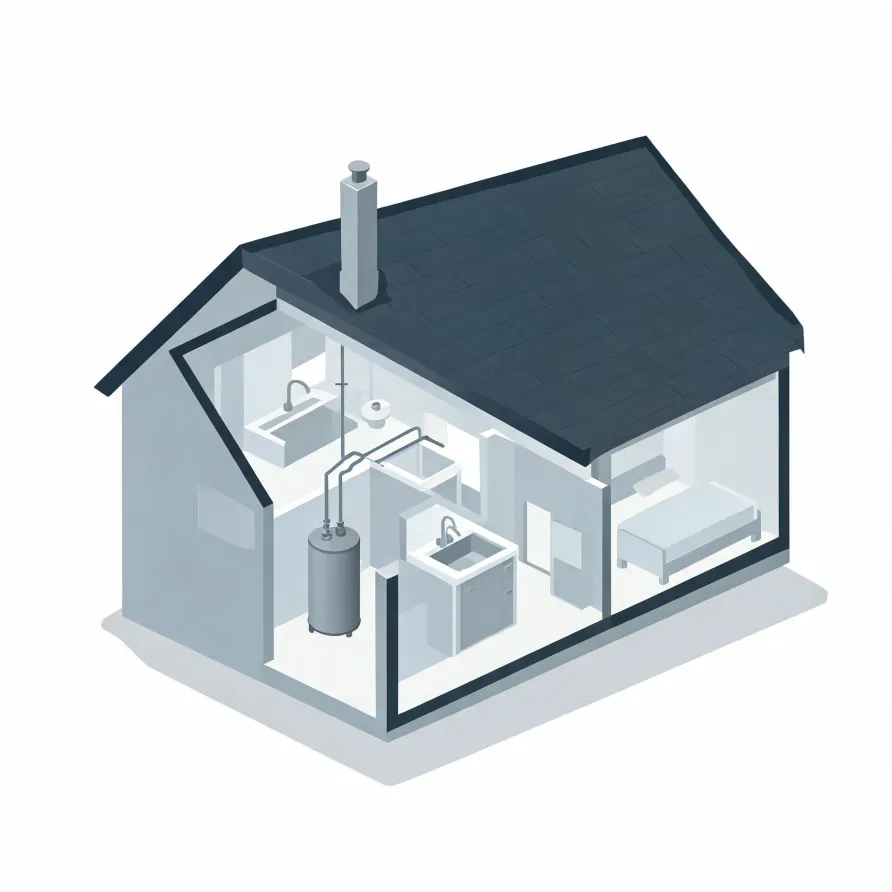
The tank is what most homeowners notice: a large insulated cylinder that sits in a utility room, basement, or garage and holds the home's supply of hot water. Attached to the top are the hot and cold water lines, and near the base sits the drain valve. The thermostat and heating element, or burner assembly on a gas unit, sit within or against the tank body and are the pieces a contractor goes to when water stops getting hot or stops holding temperature.
The pressure relief valve mounts to the side of the tank and opens automatically if pressure or temperature climbs too high inside. Running from the tank are the supply and return lines that carry water through the house. The anode rod sits inside the tank itself, slowing corrosion, and a contractor will pull it to judge the condition of the tank's interior when other symptoms point that direction.
The drawing shows a typical water heater layout, and a licensed contractor determines which parts apply and what condition they are in for your specific installation.
Get matched in Limestone CountyLimestone County, by the numbers
228 severe weather events were recorded in Limestone County, Alabama between 2015 and 2024.
NOAA National Centers for Environmental Information, Storm Events Database, bulk CSV export, events 2015-01-01 through 2024-12-31.Half the homes in Limestone County, Alabama were built in 1998 or earlier (2020-2024 ACS 5-year).
U.S. Census Bureau, 2020-2024 American Community Survey 5-Year EstimatesLimestone County, Alabama holds 44,354 housing units (2020-2024 ACS 5-year).
U.S. Census Bureau, 2020-2024 American Community Survey 5-Year EstimatesOwners occupy 77.6% of the occupied homes in Limestone County, Alabama (2020-2024 ACS 5-year).
U.S. Census Bureau, 2020-2024 American Community Survey 5-Year EstimatesCodes & Standards Governing Water Heater Repair in Limestone County, Alabama1 sourced rules and standards
Licensing Rules for HVAC Repair in Limestone County, Alabama
Alabama requires state certification to do heating, air conditioning and refrigeration contracting: nobody may advertise, bid, pull permits or do the work unless the person in responsible charge is a certified contractor.
Severe Weather Events in Limestone County
Storms put stress on water heaters through power surges, pressure fluctuations, and prolonged demand when outages end and systems restart all at once. How often that stress arrives is a local fact, and it shapes how hard the equipment in this area works.
228 severe weather events, 2015–2024. Source: NOAA National Centers for Environmental Information, Storm Events Database.